
Personal Alarms for Women
Our Top Personal Alarms for Women


What to Look for in a Women’s Personal Alarm
A personal alarm is only useful if it’s accessible when something happens — and what happens rarely unfolds slowly. Most threatening situations escalate in seconds, not minutes. The right alarm for a woman isn’t necessarily the loudest or the most feature-packed. It’s the one that’s actually on her and deployable in a single motion when adrenaline is spiking and time is short.
Activation should be one motion, one hand. Pin-pull alarms are the gold standard for this. You pull the cord, the alarm screams, and the attacker’s advantage disappears. Button-press models can also work, but the button needs to be large, obvious, and reachable without looking. Avoid any alarm that requires pressing and holding, twisting a cap, or using both hands.
Carry placement determines response time. An alarm buried in the bottom of a bag is functionally useless in a fast-moving situation. The best carry positions for women are: clipped to the outside of a bag strap, on a keychain, looped around a wrist, or in a front jacket pocket. Wherever you carry it, practice reaching for it a few times — the motion should be automatic.
Loudness above 120dB creates real deterrence. Most people have never been next to a 130dB alarm when it fires. It’s deeply disorienting, even to the person holding it. For a potential attacker, the combination of that noise, the attention it draws, and the total loss of the element of surprise is an overwhelming reason to disengage. A 90dB alarm is noticeable; a 130dB alarm is overwhelming.
Discreet design reduces the chance it gets left behind. The Lipstick Personal Alarm is designed to look like an ordinary tube — it doesn’t visually broadcast “safety device” in a way that some women find uncomfortable to carry openly. If you’re more likely to keep something in your bag because it doesn’t look clinical or tactical, that’s the right choice. The best alarm is always the one you actually have with you.
How Women Carry Personal Alarms: The Four Best Options
On a keychain is the most natural carry method for women who already use their keys as a security ritual — pressing them in-hand when walking to their car, for example. Keychain placement means the alarm is already out before you need it. The Keychain Alarm with Flashing Light is designed specifically for this: pin-pull activation so there’s no extra step between grip and deployment.
Clipped to a bag strap or tote keeps the alarm on the outside of your bag where it’s instantly reachable without opening anything. The Mini Personal Alarm’s belt/visor clip works well on a bag strap, backpack loop, or stroller handle. One-hand draw, no fumbling.
On a wrist lanyard is an underrated option for women running, commuting, or doing anything where a bag isn’t nearby. The cord loops around the wrist so that pulling or dropping your arm automatically arms or triggers the alarm. This is the most hands-free option available.
In a front pocket or jacket pocket works for women who don’t carry bags or want a backup carry point. The Lipstick Personal Alarm is slim enough to drop in any coat pocket without a noticeable profile.
Personal Alarms and Situational Awareness: What Actually Prevents Incidents
A personal alarm is a reactive tool — it works after a threat has presented itself. The most effective use of a personal alarm is in combination with the habits that reduce risk before anything happens:
Walking confidently and purposefully is documented to reduce the likelihood of being targeted. Looking up, making brief eye contact, and moving with a clear sense of direction all signal that you are paying attention — the opposite of a person who looks distracted or uncertain.
That said, situational awareness isn’t a substitute for having a tool. Attacks happen to attentive, capable, prepared people. A 130dB alarm in your hand is what turns a dangerous situation into a loud, public, attention-drawing one — which is exactly what most opportunistic threats are designed to avoid.
For women who want a layered approach, a personal alarm pairs naturally with a compact pepper spray. The alarm creates distance and draws attention; the pepper spray provides stopping power if the alarm doesn’t resolve the situation. See our Pepper Spray for Women page for recommendations that complement the alarms above.
Personal Alarms for Specific Situations Women Face
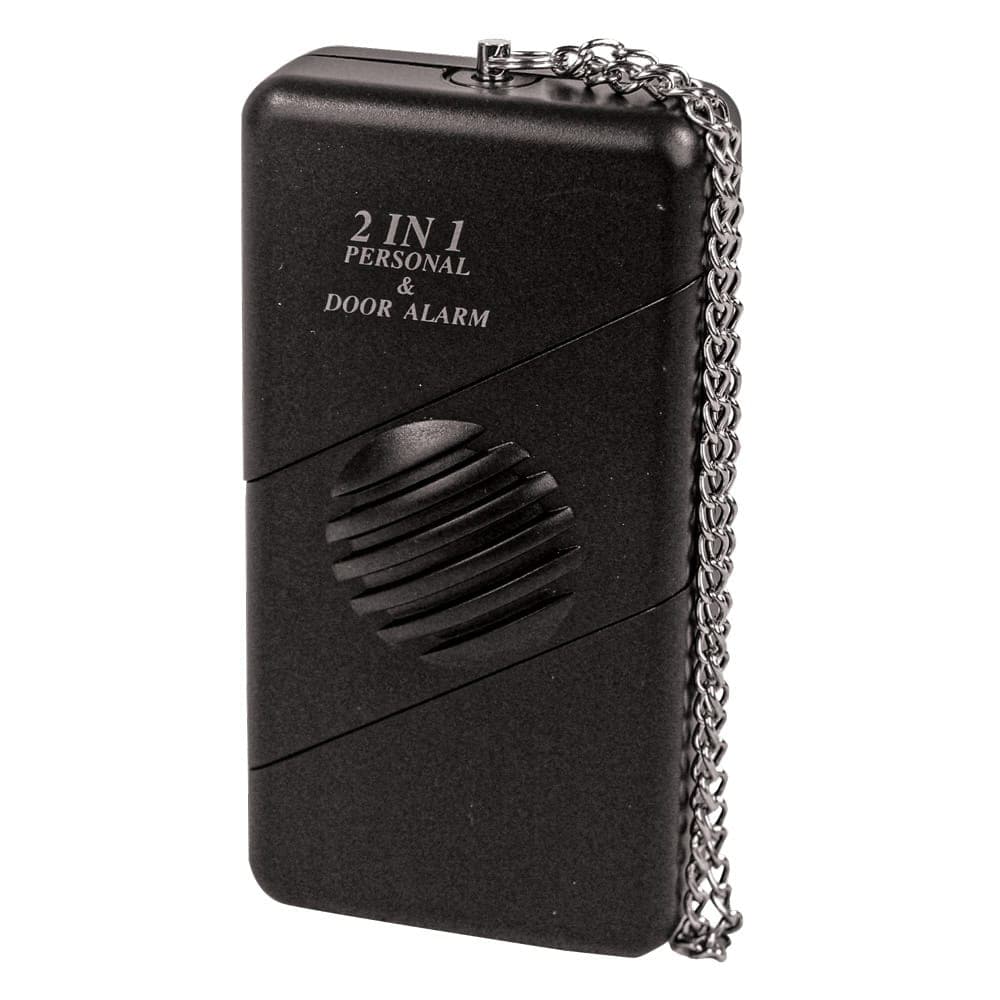
College campuses: The 2-in-1 Personal & Burglar Door Alarm is an especially practical choice for college students — it carries on a keychain during class and transitions to door alarm mode in a dorm room at night. Campus housing typically doesn’t allow bolt locks or door bars, but a door alarm requires no installation and can’t be prohibited.
Late-night work commutes: The Personal Panic Alarm with 350-Lumen Strobe doubles as a flashlight-level emergency signal in dark parking structures or transit stations. The strobe is visible from a significant distance and can flag down help even when a siren alone might not carry.
Running and walking alone: Keychain and pin-pull models are best for active carry — see our dedicated Personal Alarms for Runners page for route-specific recommendations including wrist-carry options.
Travel: Hotel rooms, Airbnbs, and unfamiliar cities all present different risk profiles than home. The 2-in-1 door alarm and the 3-in-1 alarm (which includes a door/window sensor mode) are purpose-built for exactly this scenario. See our Personal Alarms for Travelers page for full travel-focused guidance.
Frequently Asked Questions
Need Help Choosing?
Not sure which alarm fits your routine, your carry style, or your specific situation? Call us at 800-859-5566 — we'll help you find the right match.
Shop All Personal Alarms