
Personal Alarms for Travelers
Our Top Picks for Runners and Joggers



What Travelers Need from a Personal Alarm
Most personal alarm buying guides are written for people who park in the same garage every night and run the same neighborhood loop three times a week. Travelers have a completely different set of requirements — and a completely different set of risks.
Multi-function devices earn their weight. Every item in a carry-on has to justify its presence. The 3-in-1 Personal Alarm — which covers personal carry, flashlight duty, and hotel door security — does the work of three separate devices at under $12 and fits in a shirt pocket. For travelers, this is the most efficient purchase in the lineup.
Door security is the gap most travelers don’t think about. Hotel deadbolts and swing bars can be defeated by staff master keys. Airbnb locks vary wildly in quality. Hostel room doors sometimes have no secondary lock at all. A door alarm doesn’t prevent entry — it makes unauthorized entry immediately loud, which is functionally the same thing at 2 a.m. when the goal is to wake you up and alert anyone nearby.
No subscription, no roaming charges, no app. The alarm works the same in Tokyo as it does in Jacksonville. It doesn’t need your phone to be charged, doesn’t require cellular service, and won’t fail because your international data plan isn’t configured. Battery-powered reliability is the point.
TSA compliance matters before you ever get to the destination. Every alarm in this lineup uses button cell or small alkaline batteries, contains no aerosol, no liquid, and no restricted components. All are carry-on safe. None will trigger secondary screening based on what they are (though any electronic device may be asked to be powered on for demonstration — a simple button press handles this).
Size and weight should be invisible. The heaviest alarm on this page weighs just a few ounces. For long-haul travelers tracking every gram of carry-on weight, that’s effectively nothing. Pack two — one for personal carry and one staged at the hotel room door — and you’ve added less than half a pound to your bag.
How to Use a Personal Alarm in a Hotel Room
This is the most underused feature set in this entire product category, and it’s one of the most valuable for travelers.
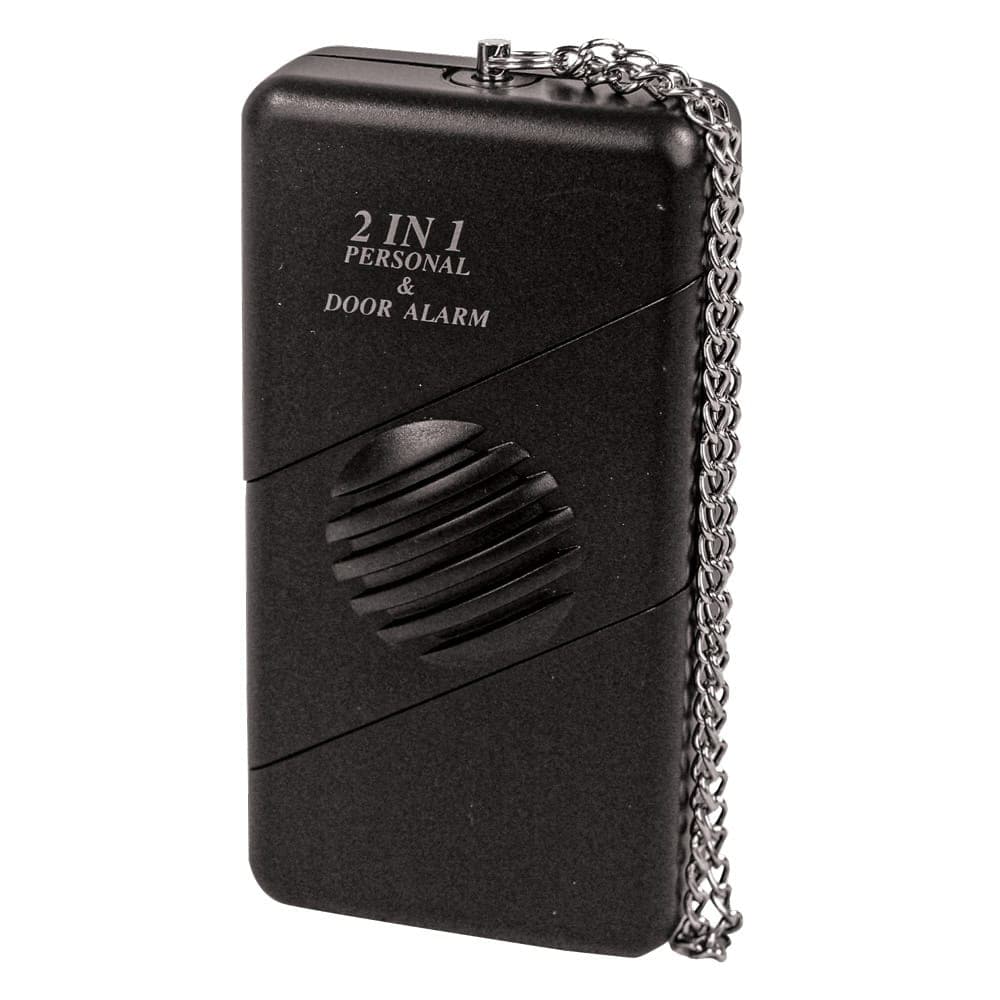
The 3-in-1 Personal Alarm and the 2-in-1 Personal & Burglar Door Alarm both include a door sensor mode that triggers the alarm if the door is opened while activated. Here’s the standard setup routine:
Step 1: Check in and survey the door. Note whether the deadbolt functions, whether there’s a swing bar, and whether the gap under or around the door is unusual.
Step 2: Engage all mechanical locks first — deadbolt, swing bar, or door bar if available. A personal alarm is a supplement to mechanical security, not a replacement.
Step 3: Hang or clip the alarm in door-sensor mode on the door handle or thread it through the door handle so that any movement of the door pulls the activation cord. On models with a dedicated door sensor mode, follow the product instructions for placement — typically hooking through the door handle with the pull-cord taut.
Step 4: When you leave for the day, switch the same device to personal carry mode and take it with you. One alarm, two full days of coverage.
For hostels or accommodations with shared common areas, the alarm also works on a window latch or a room locker — anywhere you want an audible alert if something is moved.
Personal Alarms for Solo Travelers: The Specific Risks Worth Preparing For
Solo travel — whether for business or leisure — concentrates risk in ways that group travel spreads out. A few scenarios where a personal alarm is specifically useful:
Unfamiliar transportation. Rideshares, taxis, and public transit in cities you don’t know present risks that are harder to assess than in familiar environments. A personal alarm in your jacket pocket, pre-armed and accessible, gives you an immediate option if a ride or encounter turns uncomfortable before you can reach a door.
Late arrivals. Flights that land at midnight. Trains that pull in at 2 a.m. Bus stations that are empty except for you and a few strangers. These are the situations where your situational awareness is lowest — you’re tired, disoriented, often loaded with luggage — and where an accessible alarm is most worth having.
Exploring on foot. Day travel in new cities often involves navigating on a phone with your head down, which signals distraction to anyone looking for an opportunity. Keeping an alarm clipped to a bag strap or pre-held in your hand during navigation-heavy stretches costs nothing and removes the most accessible window a threat has.
Accommodation transitions. The walk from a rideshare drop-off to a hotel entrance, or from a vacation rental to a nearby restaurant, involves brief stretches of street exposure in an area you haven’t mapped yet. These transitions are brief but worth being prepared for.
Are Personal Alarms Allowed in Other Countries?
Personal alarms have no moving parts, contain no chemicals, and fire nothing — they make noise. As a result, they face essentially no import, carry, or ownership restrictions in any country we’re aware of. Unlike pepper spray (which is restricted or prohibited in many countries) or stun guns (which are outright banned in most of the world outside the U.S.), a personal alarm travels freely.
That said, the general rule for any self-defense product and international travel applies: confirm with your destination country’s customs authority before packing, especially for extended international stays. For most leisure and business travel, a personal alarm is by far the simplest, least legally complicated safety tool you can carry across a border.
For domestic U.S. travel, personal alarms are legal to carry and possess in all 50 states with no age, size, or registration requirements.
Frequently Asked Questions
Heading Out Soon?
If you're preparing for a specific trip and want help choosing the right alarm setup for your destination, accommodation type, or travel style, call us at 800-859-5566. We'll help you pack smart.
Shop All Personal Alarms